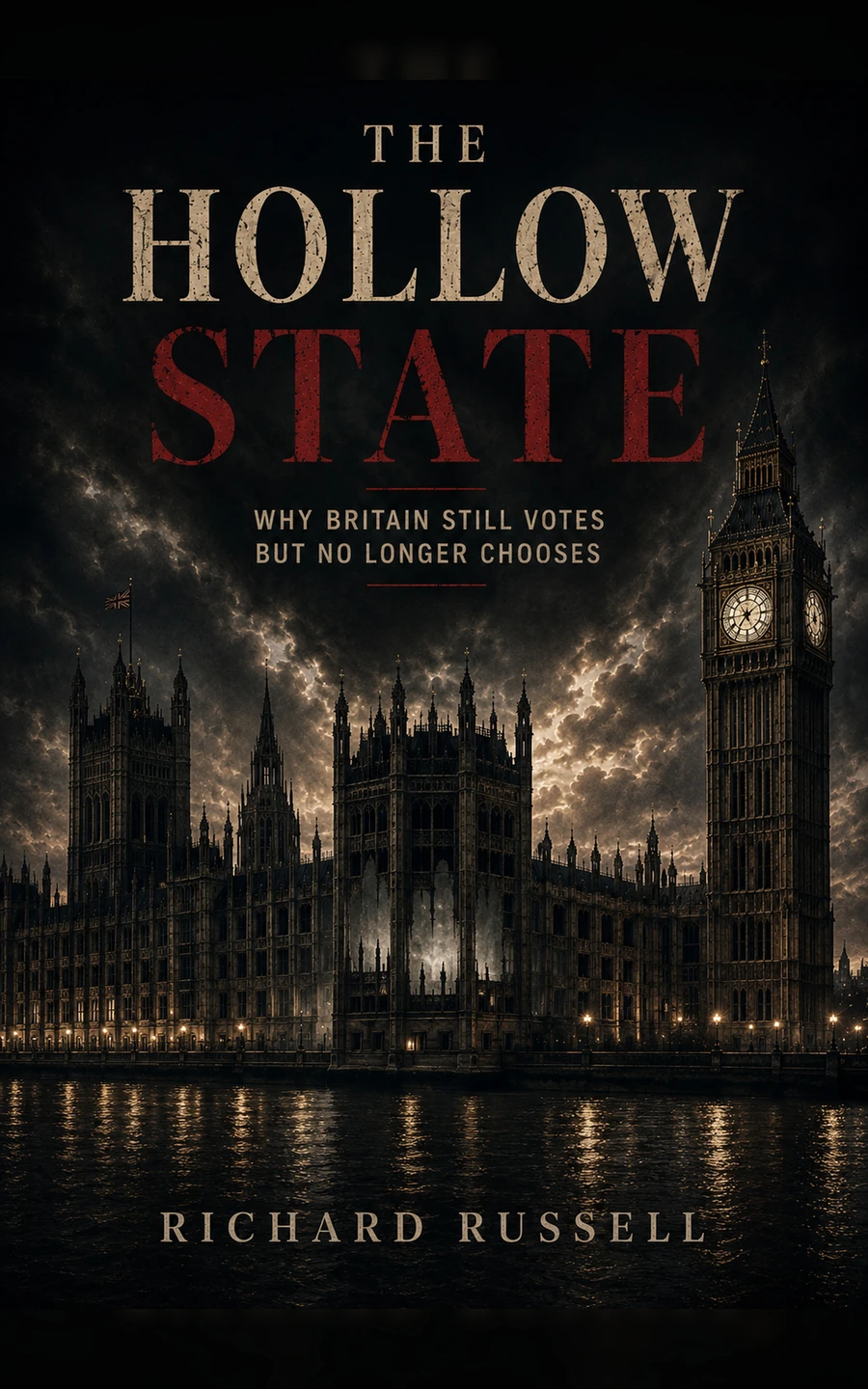
Evidence is dated to the periods stated. The argument and reform proposals are Richard Russell’s; linked sources do not imply endorsement. Original PDFs are retained and may differ from this web edition.
A vote needs a delivery system
Brexit was sold as the return of control. My argument in The Hollow State is that it also exposed how difficult Britain finds turning political instruction into practical capability.
That argument needs a fair test. Leaving a customs union and single market necessarily changes the terms of trade. Friction can result from the policy chosen, even when officials implement it competently. Political disagreement about the destination is not, by itself, evidence of administrative obstruction.
The useful question is more precise: once ministers had chosen a direction, did government give businesses and public bodies a credible route to delivering it?
A documented test: the trade border
The National Audit Office's May 2024 report on the trade border provides a concrete case. Its evidence covered the period up to April 2024; it did not assess the controls introduced from 30 April that year. It examined the movement of goods, including the distinct arrangements for Northern Ireland. This is a historical implementation assessment, not a claim about every border process today. [1]
The NAO identified the difficulty of coordinating major programmes across departments and external organisations. Its conclusions called for clearer delivery accountability, more credible digital implementation and better performance assessment. Those are recognisable programme-delivery problems. They concern ownership, dependencies and measurement, rather than the merits of either referendum campaign. [1]
This matters because a border is a working system. A legal requirement has to become a process that a trader can understand, software that can exchange information, infrastructure that is ready, and a service that handles exceptions. If one component is missing, the burden moves elsewhere in the chain.
The political decision and the delivery system should therefore be evaluated separately. A process may run as designed while imposing costs that are inherent in the chosen trading relationship. Conversely, an avoidable implementation failure should not be excused simply because the underlying policy was difficult.
What the economic evidence can tell us
The Office for Budget Responsibility's Brexit analysis describes a long-run productivity assumption of 4% below a scenario in which the UK remained in the EU. It also assumes imports and exports will each be around 15% lower in the long run than under that counterfactual. These are model-based comparisons underpinning its forecast, not measurements of an economy that can be observed alongside the actual UK. [2]
Those estimates deserve scrutiny, but so does the way they are used. They do not mean that GDP fell by 4% on referendum day. Nor do they establish that every later movement in investment or trade was caused by Brexit. The OBR describes its assumptions and the evidence it uses to assess them; readers should distinguish that exercise from a claim of experimental proof. [2]
My argument does not require one forecast to carry the whole case. It asks whether restored legal discretion was matched by a clear economic strategy and the capacity to execute it. That is a question for institutions, ministers and delivery organisations as well as economists.
The strongest counterargument
A reasonable objection is that the electorate chose a constitutional direction, not a detailed operating model. Negotiation depended on another party. Ministers faced competing objectives, and parliamentary scrutiny was part of democratic government rather than a defect in it.
That objection is important. We should not treat every compromise as betrayal or every delay as evidence of bad faith. Northern Ireland, market access and regulatory autonomy could not be made compatible simply by asserting that they should be.
But complexity strengthens the case for honest choices before commitments are made. It does not remove the obligation to assign responsibility, prepare implementation and explain the consequences. A mandate confers political authority; it does not supply systems, staff or infrastructure automatically.
What a credible delivery model would show
I would judge a major constitutional programme against five practical questions:
- Is the intended outcome clear enough to distinguish delivery from activity?
- Are the costs and trade-offs published, including who bears them?
- Does each cross-departmental dependency have an accountable owner?
- Can affected organisations test processes before they must rely on them?
- Are performance and corrective actions reported after launch?
These are proposed tests of competence, not a retrospective claim that any one delivery method would have removed every cost. A well-managed programme can reveal that a promise is incompatible with its constraints. Its duty is then to surface the choice, not conceal it.
The democratic lesson
Brexit was the X-ray because it made the relationship between consent, political choice and institutional capability unusually visible. That is my interpretation of the case; it is not a conclusion attributed to the NAO or OBR.
Citizens should be able to change national direction. They should also be told what the chosen direction requires and where its limits lie. Neither dismissing the vote nor treating it as a substitute for preparation meets that standard.
A border cannot be delivered by a speech. Democratic control becomes meaningful when the institutions entrusted with it can make decisions work—and account openly for the decisions that cannot work as promised.
READ THE EVIDENCE
Sources & further reading
- National Audit Office — The UK border: implementing an effective trade border
20 May 2024; evidence to April 2024; movement of goods and delivery/accountability findings.
- Office for Budget Responsibility — Brexit analysis
March 2026 forecast assumptions; long-run counterfactual productivity and trade effects, not measured losses.