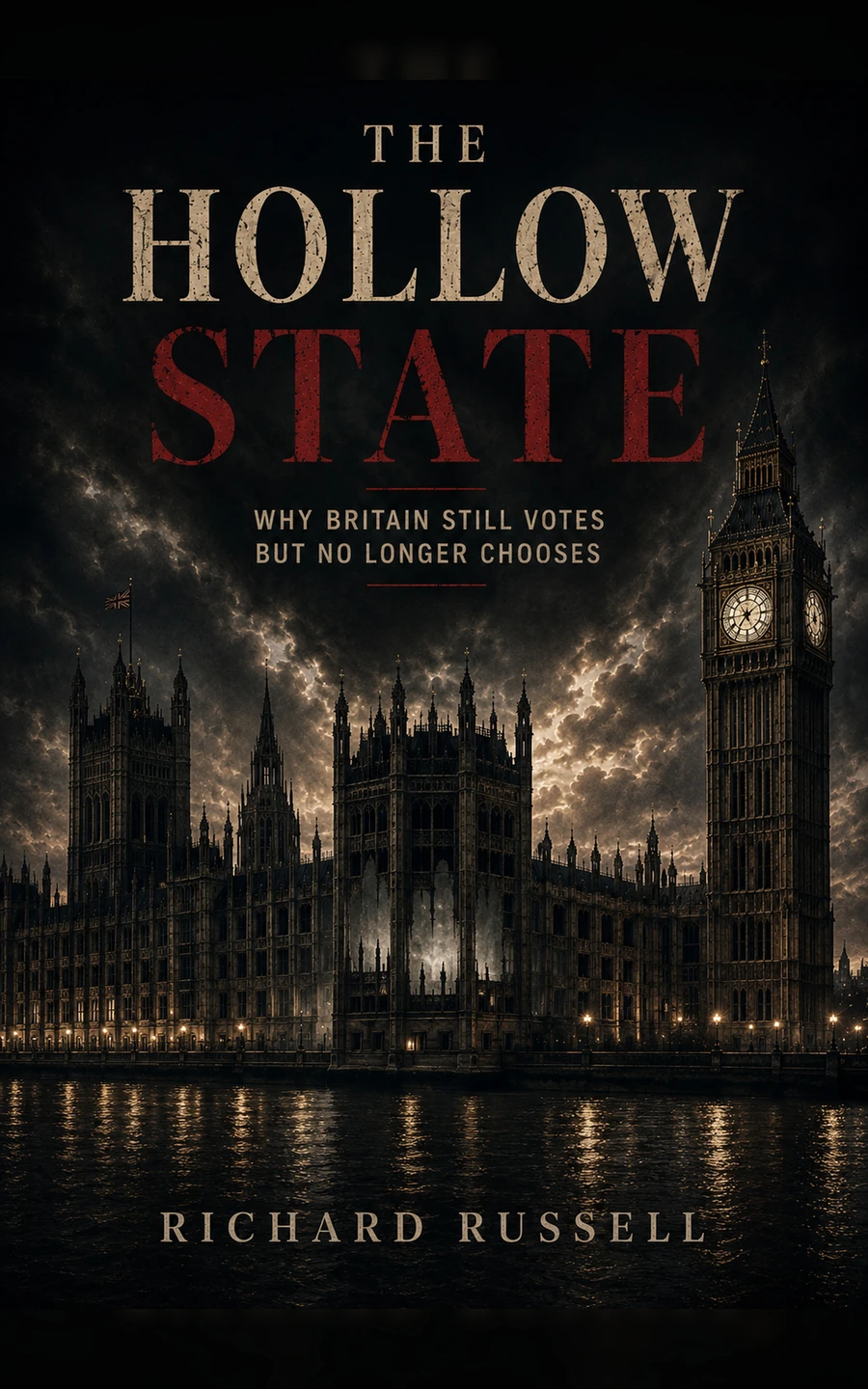
Evidence is dated to the periods stated. The argument and reform proposals are Richard Russell’s; linked sources do not imply endorsement. Original PDFs are retained and may differ from this web edition.
Correction without permanent crisis
Democracy V2 should not mean government by app. It should mean representative government in which consent, scrutiny and correction remain meaningful between elections.
This is a reform proposal, not a description of powers citizens already possess. Its starting point is the argument in The Hollow State: public power is delegated, and institutions should be able to explain how they use it and how serious failure can be corrected.
The difficult question is how to strengthen that correction without making government unstable, allowing organised groups to dominate participation, or exposing basic rights to every passing majority.
Begin with the powers that already exist
The UK already has a statutory recall process for MPs, but it is not a general mechanism for removing an MP because constituents disagree with a policy. The House of Commons Library describes defined triggering conditions and a petition threshold of 10% of eligible registered electors. A successful petition creates a vacancy and a by-election; it does not simply appoint a replacement. [1]
That distinction illustrates why reform needs precision. A proposal to expand recall must say what new trigger it would create, who determines that the trigger is met and what safeguards apply. It should not imply that a power already exists merely because a petition can be started online.
Make major commitments inspectable
My first proposal is a public register of a government's principal commitments. Each would state the intended outcome, responsible minister, delivery dependencies, evidence and review date.
This would not turn every manifesto sentence into a court-enforced contract. Circumstances change, and elected representatives need judgement. But a major reversal should require an explicit explanation to Parliament, a published assessment of alternatives and a recorded decision about the new course.
The purpose is to make changed choices visible. It would remain legitimate to change policy; it would become harder to present an abandoned commitment as though nothing had changed.
A bounded route to public challenge
My second proposal is to examine a citizen-triggered challenge for a narrowly defined class of major decisions. Parliament would first have to legislate its scope, thresholds, timetable and legal effect. Those details cannot be replaced by the phrase “let the people decide”.
The design would need independently verified participation, transparent funding, accessible offline routes and rules preventing repeated challenges to the same decision within a defined period. Thresholds would require public consultation and testing; this briefing does not pretend to have derived an optimum number.
Question wording matters too. The Electoral Commission already assesses referendum-question intelligibility and sets out criteria including clarity and neutrality. A new mechanism should build on that expertise rather than let the government or campaign determine the ballot wording unchallenged. [2]
Rights and emergencies need explicit safeguards
A constitutional mechanism should not permit a temporary majority to remove the basic rights or equal citizenship of a minority. My proposed design would require an independent legal admissibility review, with published reasons and an appeal route, before a question could proceed.
That introduces a real tension: the reviewer would exercise power over which questions citizens can decide. Its remit must therefore be narrow, established in law and itself accountable. A rights safeguard cannot become an unexplained veto on political disagreement.
Emergency action also needs room to operate. Requiring a prior public vote for every urgent decision could be dangerous. I propose time-limited emergency exceptions, prompt parliamentary scrutiny and a requirement to seek renewed authority if exceptional powers must continue. Urgent defence cannot always wait for a ballot.
These are constitutional design principles requiring detailed development. They are not claims about the present legal effect of a petition or referendum.
Consequence should follow responsibility
My third proposal is a clearer public record of institutional remedies after serious failure. It should identify which recommendations were accepted, who must act and what evidence demonstrates completion.
Sanctions require due process. An unsatisfactory outcome does not automatically establish misconduct, and an individual should not be punished for a decision outside their authority. Any extension of disciplinary powers would require defined grounds, proportionality and an appeal mechanism.
The objective is reliable correction, not a public ritual of finding someone to blame. A system that assigns responsibility without authority can produce defensive reporting instead of better delivery.
Technology should support deliberation
Digital tools can make evidence easier to inspect, compare proposals and track commitments. They should complement accessible public processes, with offline participation available.
This briefing does not propose online voting as the default. The secrecy of a ballot, freedom from coercion, security and confidence in the result require a different standard from collecting views on a website. A popular interface is not proof that the underlying democratic process is trustworthy.
The strongest counterargument
More veto points can empower well-organised campaigns, slow necessary decisions and weaken the responsibility of elected governments. The reform could reproduce the very paralysis it is intended to address.
That is why scope and safeguards belong at the centre of the proposal. Start with transparent commitments, evidence and follow-through; evaluate any stronger mechanism against participation, fairness, correction and the ability to govern. Do not equate the number of consultations with the quality of consent.
Representative democracy should remain the foundation. The aim is to make delegated authority more answerable and correction more credible, while retaining the capacity to act.
Power should be delegated, not surrendered. Making that principle work requires institutional design as serious as the criticism that prompted it.
READ THE EVIDENCE
Sources & further reading
- House of Commons Library — Recall elections
Defined statutory triggers, 10% eligible-elector threshold and by-election; not a general policy-disagreement recall power.
- Electoral Commission — Referendum question research
Existing question-intelligibility role and neutrality guidelines, not authority to create the proposed new mechanism.